
The EU Strategy for the Danube Region (EUSDR) is a macro-regional strategy adopted by the European Commission in December 2010. The area covered by the EUSDR is mainly the basin of the 2.857 km long Danube River, including also the parts of the mountain ranges where its tributaries originate (like the Alps, or the Carpathians). It stretches from the Black Forest (Germany) to the Black Sea (Romania-Moldova-Ukraine) and is home to around 115 million inhabitants. Involving 14 countries, it is the largest and most diverse macro-regional strategy: nine EU Member States (Austria, Bulgaria, Croatia, Czechia, parts of Germany, Hungary, Romania, Slovakia, Slovenia), three Accession Countries (Bosnia and Herzegovina, Montenegro, Serbia) and Ukraine & Moldova. The Danube Region Strategy addresses a wide range of issues; these are divided among 4 pillars and 12 Priority Areas. The Danube Region Strategy Area 8 aims to support the competitiveness of enterprises in the Danube Region. Given the complexity of the tasks of the Priority Area 8, it is imperative to set up Working Groups. Their role is to reveal, synthesize and present concrete projects, which are in line with the Actions set for the Danube Region Strategy by Priority Area 8. The Priority Area Coordinators together with the Steering Group established six thematic Working Groups ( Innovation and Technology Transfer, Digital Danube, Artifical Inteligence, Cluster and Regional Development, Female Enterpreneurship, Circuler Economy and Bioeconomy).
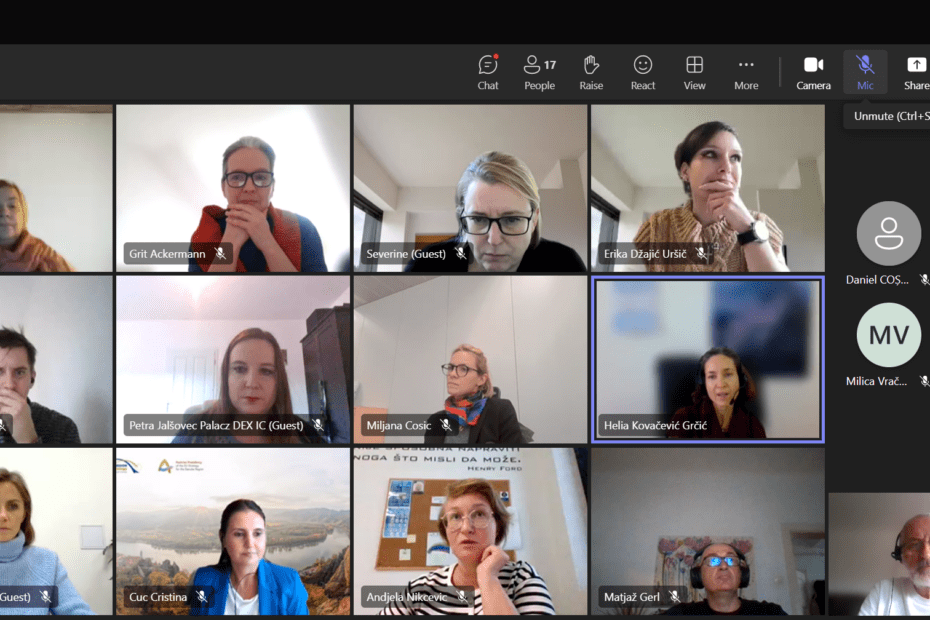
The initiative to establish a working group on the circular economy and bioeconomy was launched at the Steering Group Meeting, as well as the Bioeconomy Conference on September 21, 2023 in Zagreb. In the middle of 2024, co-coordinators (Grit Ackermann and Goran Vasić) were appointed, who had the task of establishing the work of this new working group. WG Circular economy and bioeconomy was officially formed on November 24, 2024 in online format.
The newly formed working group was opened by Helia Kovačević Grčić, coordinator for priority area 8 from the Croatian Ministry of Economy. Helia expressed her commitment to supporting the group’s activities and facilitating networking among members. Cristina Cuc, Pilar Officer Danube Strategy Point, wished successful work to the members of the working group and expressed her intention that in the future we will cooperate closely on the implementation of projects and initiatives.